Reducing Fire and Wildfire Risk
One Fire Can Affect an Entire Community: Reducing Fire and Wildfire Risk in Utah Associations
By Tanner Weston, HOA Insurance Specialist, USI Insurance Services
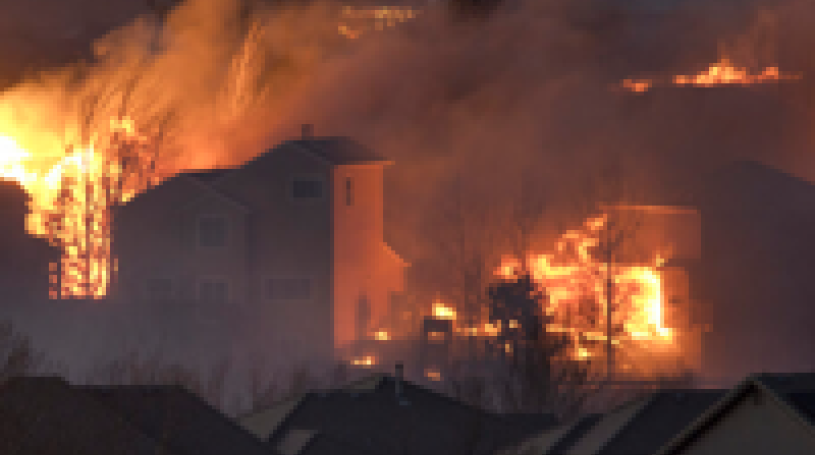
A fire in a multifamily community is rarely confined to one household. Shared walls, attics, roofs, and balconies allow heat and smoke to travel, while suppression water can damage units far from the point of origin. Even when everyone escapes safely, residents may lose their homes and possessions within hours.
Utah received a painful reminder on July 31, 2026, when a four-alarm fire tore through the North Union Apartments in Midvale. All 220 occupied units were evacuated, displacing hundreds of residents. The fire burned for more than 24 hours, and investigators preliminarily attributed it to a mechanical issue in the attic. Fourth-floor residents initially could not return; others retrieved what remained after extensive fire, smoke and water damage. The Salt Lake Tribune reported that most tenants had “essentially lost everything.”
The aftermath also revealed an insurance misunderstanding. Residents said they believed a monthly program arranged through the property would protect them but learned it provided liability coverage—not personal-property or additional-living-expense coverage.
Although North Union is a rental property rather than a community association, the lesson applies to association living: master and individual policies serve different purposes, and those responsibilities should be explained before a loss.
Start With the Most Preventable Fire Hazards
Boards cannot eliminate every fire risk, but clear rules, consistent enforcement and scheduled maintenance can address common ignition sources.
Keep grills of balconies and away from buildings. Charcoal, propane and other open-flame cooking devices should not be used on balconies, beneath overhangs or near combustible construction. NFPA guidance calls for at least 10 feet of separation; local codes may be stricter. Associations can provide designated grilling areas on noncombustible surfaces away from buildings and landscaping. Send seasonal reminders and enforce violations consistently. Electric grills should also be reviewed with the local fire authority rather than assumed risk-free.
Make cooking safety part of resident education. U.S. Fire Administration data show that cooking accounted for 74% of multifamily building fires from 2017 through 2019. Remind residents to stay in the kitchen, keep combustibles away from cooking surfaces and never use water on a grease fire.
Maintain electrical and mechanical equipment. Qualified contractors should inspect and service shared panels, HVAC systems, boilers, laundry equipment and attic components. Repeatedly tripped breakers, burning odors, unusual heat or noises, and unresolved leaks deserve prompt investigation. Keep electrical and mechanical rooms free of storage, and remind residents not to overload outlets or use extension cords as permanent wiring.
Keep fire-protection systems ready. Inspect and service alarms, sprinklers, standpipes, extinguishers, fire doors, emergency lighting and exit signs on schedule. Correct documented impairments promptly. Keep hallways, stairs, fire lanes, hydrants and utility shutoffs accessible, and make addresses visible to first responders.
Plan for the day prevention is not enough. Keep emergency contacts, evacuation maps and vendor information in more than one location. Establish backup resident communications and coordinate evacuation planning with the fire department. Allow residents with access needs to request assistance voluntarily and privately.
Turn these measures into an annual operating calendar rather than a one-time memo. Assign each inspection, reminder and maintenance item to the board, manager or a qualified vendor; set completion dates; and retain the records. Review fires, alarm activations and near misses for lessons. This creates accountability, preserves continuity when volunteers or managers change and gives insurers useful evidence that the community actively manages its risk.
Clarify What the Association’s Insurance Does—and Does Not—Cover
Fire prevention and insurance planning should occur together. Annually review building valuations, deductibles, debris-removal limits, ordinance-or-law coverage and the property on the association’s schedule. Update coverage after major construction or improvements.
Give residents a plain-language explanation of the master policy and encourage them to review their HO-6 or renters coverage. Individual policies commonly address personal property, temporary living expenses, liability, interior improvements and loss assessment, subject to their terms. The Midvale fire shows why no one should assume a fee labeled “insurance” protects belongings or the cost of living elsewhere.
Wildfire Is Also a Community-Level Risk
Utah’s 2025 revaluation identified more than 700 communities at risk from wildfire. In attached housing, common landscaping, fences, decks, roofs and access roads can influence every owner’s risk, making coordinated association action especially important.
Begin with an assessment from the local fire authority or a qualified wildfire professional. NFPA’s Home Ignition Zone framework recommends a noncombustible first five feet, followed by managed vegetation and fuel reduction from five to 30 feet and 30 to 100 feet where property allows. Remove dead vegetation and ladder fuels, clean roofs and gutters, clear storage beneath decks, trim branches away from structures and screen vulnerable vents. Review fire lanes, gates, address markers and evacuation routes.
Higher-risk communities should consider Firewise USA participation or a Community Wildfire Preparedness Plan. Utah’s HB 48 framework, effective in 2026, adds assessments, risk-based fees, mitigation expectations and insurance notice requirements for high-risk wildland-urban-interface properties. Wildfire mitigation is becoming part of both community governance and insurance underwriting.
Wildfire has affected insurance cost and availability. A 2026 U.S. Government Accountability Office study associated a move from medium to high wildfire risk with an increase in homeowners insurance premiums and found that greater disaster risk can reduce market availability. Association policies differ, but carriers similarly evaluate vegetation, slope, construction, structure spacing, fire-department access, water supply and surrounding exposure. Higher risk can mean fewer insurers, increased premiums or deductibles, and more restrictive terms—even without prior history of wildfires.
Mitigation does not guarantee a lower premium, but it improves life safety and can support underwriting. Keep photographs, inspection reports, invoices, vegetation plans and board minutes. Provide them to the association’s insurance professional well before renewal so there is time to approach appropriate markets.
Effective fire-safety programs assign responsibility, document maintenance, educate residents and evolve with the property. One fire can disrupt an entire community; prevention must be a community-wide commitment.
Source Notes
- Jose Davila IV, “Residents at burned-out Midvale building say they were misled by management,” The Salt Lake Tribune, Aug. 7, 2026: https://www.sltrib.com/news/2026/08/07/midvale-apartment-fire-residents/
- Daniel Woodruf, “No timeline yet for tenants to return to Midvale apartment complex,” KSL, Aug. 3, 2026: https://www.ksl.com/article/51605548/no-timeline-yet-for-tenants-to-return-to-midvale-apartment-complex
- Daniel Woodruf, “Residents return to salvage belongings after Midvale apartment fire,” KSL, Aug. 5, 2026: https://www.ksl.com/article/51606492/residents-return-to-salvage-belongings-after-midvale-apartment-fire
- Liv Kelleher, “Residents displaced by Midvale fire begin to assess losses,” KUTV, Aug. 4, 2026: https://kutv.com/news/local/residents-displaced-by-midvale-fire-begin-to-assess-losses
- U.S. Fire Administration, “Multifamily Residential Building Fires (2017–2019)”: https://www.usfa.fema.gov/downloads/pdf/statistics/v21i7.pdf
- National Fire Protection Association, “Fire Code Grill Requirements”: https://www.nfpa.org/news-blogs-and-articles/blogs/2019/05/31/nfpa-1-proper-use-and-location-of-grills-and-other-cooking-equipment-firecodefridays
- National Fire Protection Association, “Grilling Safety Facts & Resources”: https://www.nfpa.org/education-and-research/home-fire-safety/grilling
- National Fire Protection Association, “Preparing Homes for Wildfire”: https://www.nfpa.org/education-and-research/wildfire/preparing-homes-for-wildfire
- Utah Division of Forestry, Fire and State Lands, “Wildfire Risk”: https://fsl.utah.gov/wildland-fire/prevention-preparedness/wildfire-risk/
- Utah Division of Forestry, Fire and State Lands, “Community Preparedness”: https://fsl.utah.gov/wildland-fire/prevention-preparedness/community-preparedness/
- U.S. Government Accountability Office, “Homeowners Insurance: Premiums Generally Tracked Inflation but Rose More in Disaster-Prone Areas,” Feb. 27, 2026: https://www.gao.gov/products/gao-26-107867
This article is for general informational purposes. Associations should consult their local fire authority, legal counsel and insurance professionals regarding requirements and coverage applicable to their property.