Teaching an Old Industry New Tricks: AI in Community Association Management
By Jennifer Booth, CMCA, AMS
www.knkpm.com / @knkpropertymanagement
Let's be honest: community association management is not famous for being cutting edge. This is an industry where "going digital" sometimes means scanning the paper file before putting it right back in the filing cabinet. We innovate at roughly the speed of a CC&R amendment, which is to say, after two failed votes and a parking lot argument.
I say this with love. I work in this industry, and I understand why we're careful. We manage other people's homes and other people's money, and "move fast and break things" is terrible advice when the thing you might break is someone's community.
But something is changing, and it's changing faster than anything I've seen in my career. Artificial intelligence is quietly transforming how management companies work. Not by replacing managers with robots, but by doing something much more useful: taking the busy work off our plates so we can focus on what actually matters. Relationships. Judgment. The communities themselves.
Let’s look at what that looks like in practice, because "AI" gets thrown around so much that it's started to mean everything and nothing. Here are three real projects from our work this year, and then a look at the everyday habits that have changed just as much.
From boxes of old minutes to a real roadmap
When a management company takes on a new community, someone has to become an expert on years of history, fast. Old meeting minutes, financials, contracts, insurance claims, that one drainage dispute everyone still argues about. The information is all there, technically. It's just buried in hundreds of documents that no human has time to read carefully, so most companies skim, guess, and learn the hard way over the first year.
This year we onboarded an historic condominium community with exactly that kind of paper trail: decades of minutes and records, some of them old enough to qualify as artifacts. In the past, getting oriented would have taken days of reading, and important details still would have slipped through.
Instead, we had AI read everything. Every set of minutes, every financial report, every contract. It took thousands of pages and produced a twenty page onboarding profile that summarized 50+ years of history and the most important issues facing the community, flagged the recurring problems, provided the association’s demographic information, and gave our team a roadmap for management from day one.
Here's the part that matters: the AI didn't manage anything. It read. Our team took that roadmap and spent their time on strategy, on site, and getting to know the board. The machine did the homework so the humans could do the job.
The armchair lawyer problem
Ask an attorney or the state ombudsman how they feel about AI and you may get a long, weary sigh. AI has turned everyone into an armchair expert on community association law. Owners arrive at board meetings armed with confident, occasionally correct legal theories, and professionals get to spend their time untangling them.
So, I understand the skepticism – and the frustration. But the tool isn't the problem; the way people use it is.
When our team recently responded to an ombudsman complaint, AI became our research assistant. It helped us pull together the relevant statutes, the governing document provisions, and the full history of the dispute in a fraction of the time that research normally takes. Every citation was checked. Every conclusion was ours. And the lawyer spent 15 minutes reviewing and blessing the response instead of days drafting it. The response was stronger because we could spend our time on the reasoning instead of the digging.
That's the rule we've learned, and it applies to everything in this article: the human guides the AI. The AI never leads the human. The moment that flips, you're the armchair lawyer.
A financial roadmap for the next 30 years
The same principle holds when the question is money instead of law.
One of our communities is facing significant road work over the next three decades, potentially costing millions of dollars. That's a genuinely scary number for a board. The instinct in our industry has too often been to keep dues comfortable, kick the can, and let a future board deal with it via special assessment. Ask anyone who has lived through one of those how well it will be received by the owners.
We used AI to help build a reserve study and a five-year operating budget grounded in the association's actual expenses, current economic conditions, and anticipated trends. Not generic industry averages. Their real numbers, projected forward.
The result is a financial roadmap. The board can now compare dues strategies, see what each one means for the road work, and make a decision with clear eyes. The AI ran the scenarios; the board is doing the governing. That's the difference between reacting to a crisis and planning so the crisis never arrives.
The everyday stuff
Big projects make for good stories, but honestly, the daily uses are where AI earns its keep. A few habits that have changed how we run:
- Meeting minutes. An AI notetaker attends the meeting, and AI drafts the minutes from the transcript in our standard format – a format that has been pre-programmed in, along with best practices for minutes, so all we have to say is “draft the meeting minutes”. Our AI produces a branded, legally defensible draft in seconds, with any questions flagged for verification. A human reviews and finalizes every set. Minutes that used to take hours now take minutes (pun intended, and I'm not sorry).
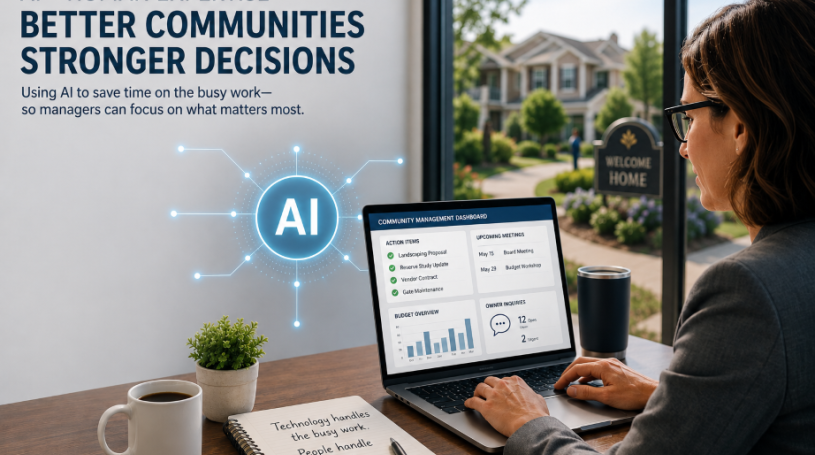
- Action item tracking. Every action item from the past week's meetings flows automatically into a weekly operations report that generates every Sunday evening, alongside our meeting calendar for the next two weeks. Each morning, I get a dashboard of what's on my plate. Nothing slips through the cracks (if it doesn’t get done, at least I know it didn’t get done), and the whole team knows exactly where things stand.
- A 24/7 assistant. Our AI chatbot (we named him Gilbert, and yes, he has a personality) answers common questions in our owner inbox and on our website. How do I log into the portal? What does the HOA actually cover? Gilbert handles the questions every management company answers a hundred times a week. Owners get instant answers at 11 p.m., and our team gets their time back for the questions that need a human.
None of these are flashy. All of them add up to the same thing: fewer hours on paperwork, more hours on people.
What this means for your community
If you're a board member or a homeowner, here's the takeaway: A management team using AI well means faster answers, better-informed decisions, and a manager with the time to actually pick up the phone.
What it doesn't mean is robots running your community. AI can read a thousand pages of minutes, but it can't sit across the table from a frustrated owner and find the solution everyone can live with. It can model a budget, but it can't earn a board's trust. It can draft, but it can't care.
That's the whole point. The technology handles the busy work. The people handle the people. And for an industry that's been stuck in the past for a very long time, that trade is long overdue.
Ready to put this into practice?
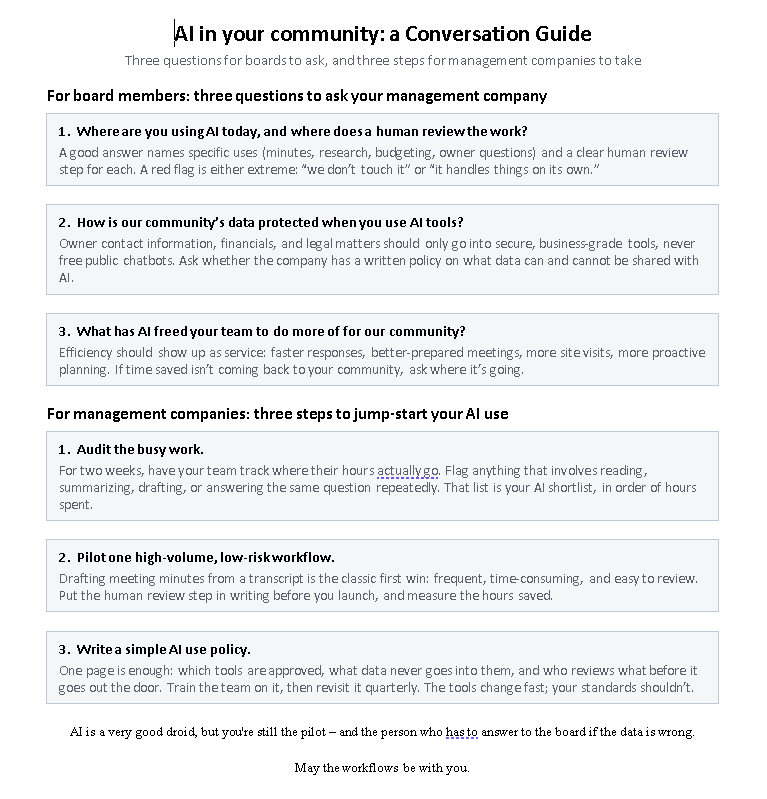
We put together a free one-page guide to help you start the conversation: three questions every board member should ask their management company about AI, and three action items management companies can use to audit and jump-start their own AI use. Download it below, bring it to your next board meeting, and see where your community stands,